I'm going to tell you something most beauty brands would rather you didn't hear.
Colour-adapting foundation isn't new. The technology has been around for years, it's long been used in lip balms and blushes, and you can buy a version on Bol.com for less than a tenner. That white stuff in those little bottles with the generic packaging: same principle, same base ingredient.
So what makes the difference? Why do some women swear by it while others get thoroughly annoyed by a result that looks "orange" or "ghostly"? And when is colour-adapting foundation really worth it?
I'm going to explain it to you, from start to finish, without beating about the bush.
How it works, because almost nobody understands it
Most colour-adapting foundations work with encapsulated pigments. Tiny capsules filled with colourant, suspended in a light, colourless base. As soon as you apply the foundation to your skin, the warmth of your skin or the contact itself makes those capsules open and release the colourant. That colourant then blends with your natural skin tone.
The most commonly used colourant is Red 27, a colourless substance that changes to a red tint on contact with the skin. That sounds alarming, but in the right concentration it gives a warm, natural pink or beige tint that suits most skin tones.
As a result, the foundation comes out lighter on someone with fair skin and slightly deeper on someone with darker skin. Not perfect for every skin tone, but for the middle range from beige to medium, where most European women fall, it works surprisingly well.
What it doesn't do: cover what isn't there. Colour-adapting foundation isn't a full-coverage product. It's an intelligent, light to medium coverage that evens out your skin tone without replacing it. If you're looking for a masking effect, you're looking at the wrong product.
Why that cheap version disappoints you
Back to that €9,49 on Bol.com. Same technology, yet a different result. How can that be?
The formula of a colour-adapting foundation is often based on a light, hydrating base that not only gives a beautiful colour but also cares for your skin. And that's exactly where the difference lies. Cheap versions use the colourant technology, but that's where they stop. The base is thin, the wear time minimal and caring ingredients are missing.
The second problem is application. Colour-adapting foundation needs a good brush to blend evenly. Without a brush, you spread the product unevenly, the capsules open fastest on the warmest areas and the result is patchy instead of even. The cheap versions are always sold without a brush. That's no coincidence.
The third problem is pigment concentration. Too little colourant and the foundation barely adapts: you just see a white layer. Too much and it becomes too dark or too red for lighter skin tones. Finding the balance takes formulation, and good formulation costs money.
Who it works best for, and who it doesn't
Colour-adapting foundation works best if your skin is fairly even and you simply want a fresh, even look without it being visible. It's the product for women who wear make-up but don't look as if they're wearing make-up. Slight imperfections, a slightly uneven skin tone, a little redness: it disappears. Large blemishes, deep acne scars or a very uneven skin tone: for those you need more coverage.
It also works particularly well for women who struggle to find the right shade. No analysing your undertone, no dried-out tester in the shop, no getting home, looking in the mirror and thinking: this isn't my colour. The foundation adapts, full stop.
It works less well for very fair skin tones, because the colourant gives a warmer tint that can come out slightly too pink or too orange on some pale skin tones. And it works less well if you need a tight, mattifying coverage all day long. That isn't what this product promises.
The brush makes the difference, not the foundation
This is the most underrated part of the story, and almost nobody talks about it.
Colour-adapting foundation in a stick has one big advantage over a foundation in a bottle: control. You apply exactly the amount you need, exactly where you want it, and then blend with a brush. No waste, no excess in one spot, no thick layer that smothers the skin.
A foundation stick with a built-in brush goes one step further: applying and blending is a single movement. That sounds like a small thing, but in practice it's the difference between a result that looks rushed and a result that feels like a second skin.
The honest story about expectations
Colour-adapting foundation does one thing very well: it makes you look fresher and more even without anyone being able to tell you're wearing anything. That's the promise, and it delivers, provided you use the right version and understand what it's meant for.
It isn't a concealer, a full-coverage foundation or a replacement for a good skincare routine. It's the make-up step for the woman who wants to support her skin rather than camouflage it. Lightweight, quick to apply, wearable all day.
And if you then look in the mirror and can't quite tell whether you're wearing make-up or simply have really good skin, it has done its job.
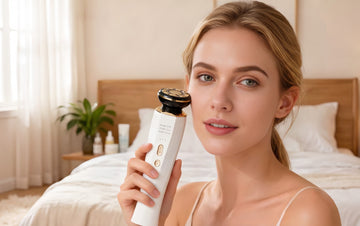
The ElleCera TonePerfect Foundation Stick combines a colour-adapting formula with a built-in brush for a finish that feels like your skin on a good day.